One chisel, carried by the Fu family for six hundred years. It began in the Song and Yuan, grew through the Ming and Qing, and still lands today in the halls, corridors and workshops on the southern slopes of the Xuefeng Mountains. It survives without a shop sign: what holds it together is a father correcting a son, sentence by sentence, cut by cut.
01
One Mountain Range, a Handful of Towns
Fushi woodcarving is spread across the southern slopes of the Xuefeng Mountains: Qiancheng, Anjiang and Xuefeng towns in Hongjiang, Pingcun in Huitong County, Huangmaoyuan and Longtan towns in Xupu County, and the Yanshan and Shanmen area of Dongkou County. These places share one landscape, one set of customs and the same timbers. The craft therefore travelled along kinship and marriage lines, town by town.
The name is not self-styled. It takes its name from transmission within the Fu family, and it became known for its long history, strong regional character, wide reach and a style of its own.
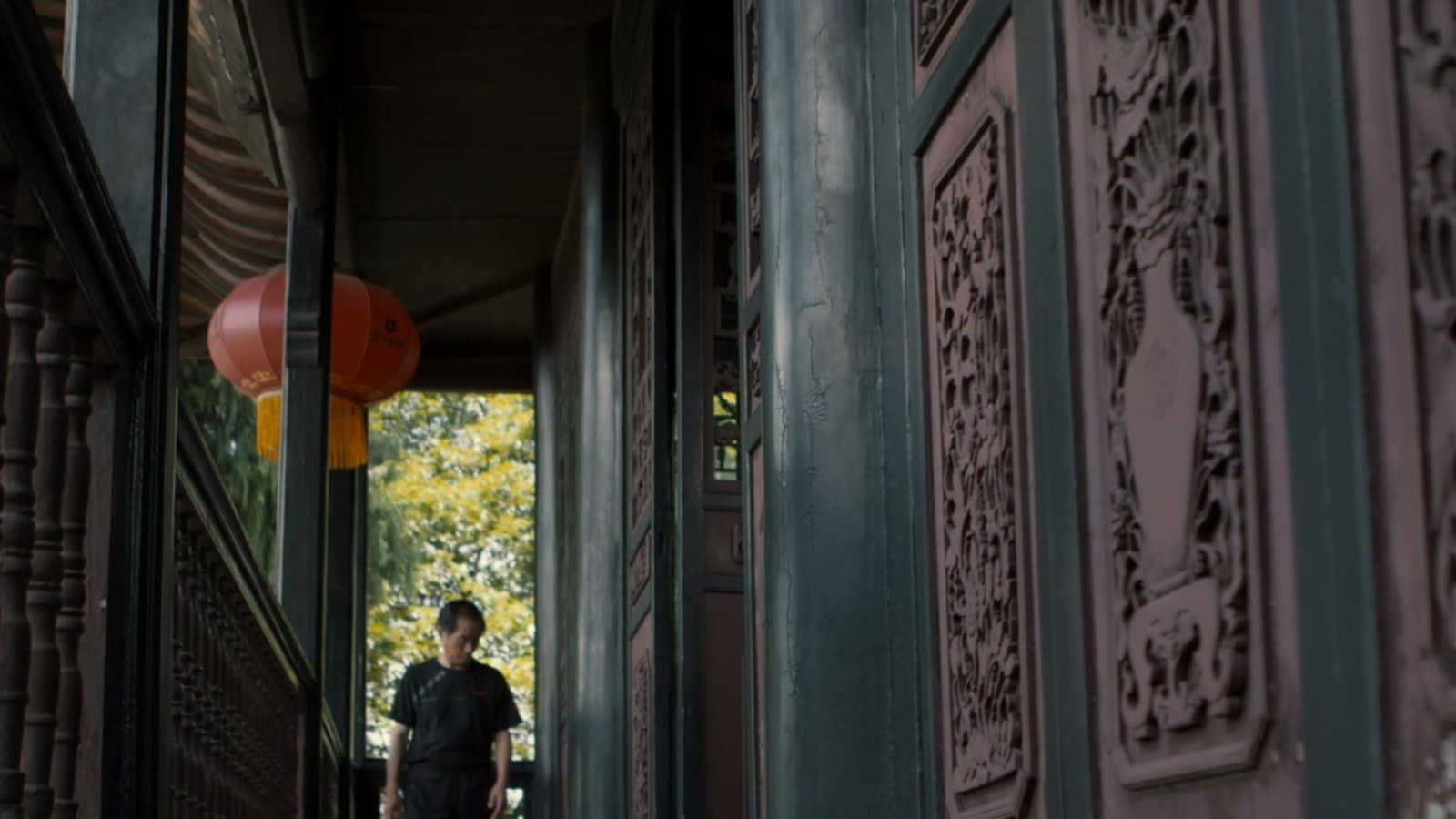
The lattice doors and panels lining a corridor: the most common home for decorative carving. It does not sit on a museum plinth; it lives where people walk every day. (Film still)
02
From the Song and Yuan to the Ming and Qing
Fushi woodcarving began in the Song and Yuan dynasties, flourished in the Ming and Qing, and has continued for more than six hundred years. Passed down inside the family, the craft kept developing and its technique grew steadily finer. By Fu Zhaohuai's generation it had reached the fourth generation in the household, and it has since passed to a fifth.
This is not a craft transmitted on paper. Patterns sit in the hands, proportion in the eye, and timing in a split-second judgement. The teacher does it once, the student watches, then tries; what comes out wrong is started again.
03
Five Categories, from Window Panels to Giant Root Carving
Decorative carving: beams, windows, lattice doors and shrine fittings, growing together with the building
Display carving: desk pieces, figures, flowers and birds, made to be seen up close
Temple sculpture: deity images and the woodwork that goes with them, where ritual and form meet
Ritual carving: wooden deities and implements used in local folk practice
Giant root carving: large works carved from a whole old tree root, following its natural form
Teak, boxwood and camphor are the principal timbers. The range runs from single figures to group compositions, from ordinary round carving to colossal root carving, with many techniques used together across a wide subject range. In temperament, the work carries both the grand scale of Central Plains culture and the sharp, unusual beauty of Huxiang culture. In the same piece the two do not fight; each holds the other up.
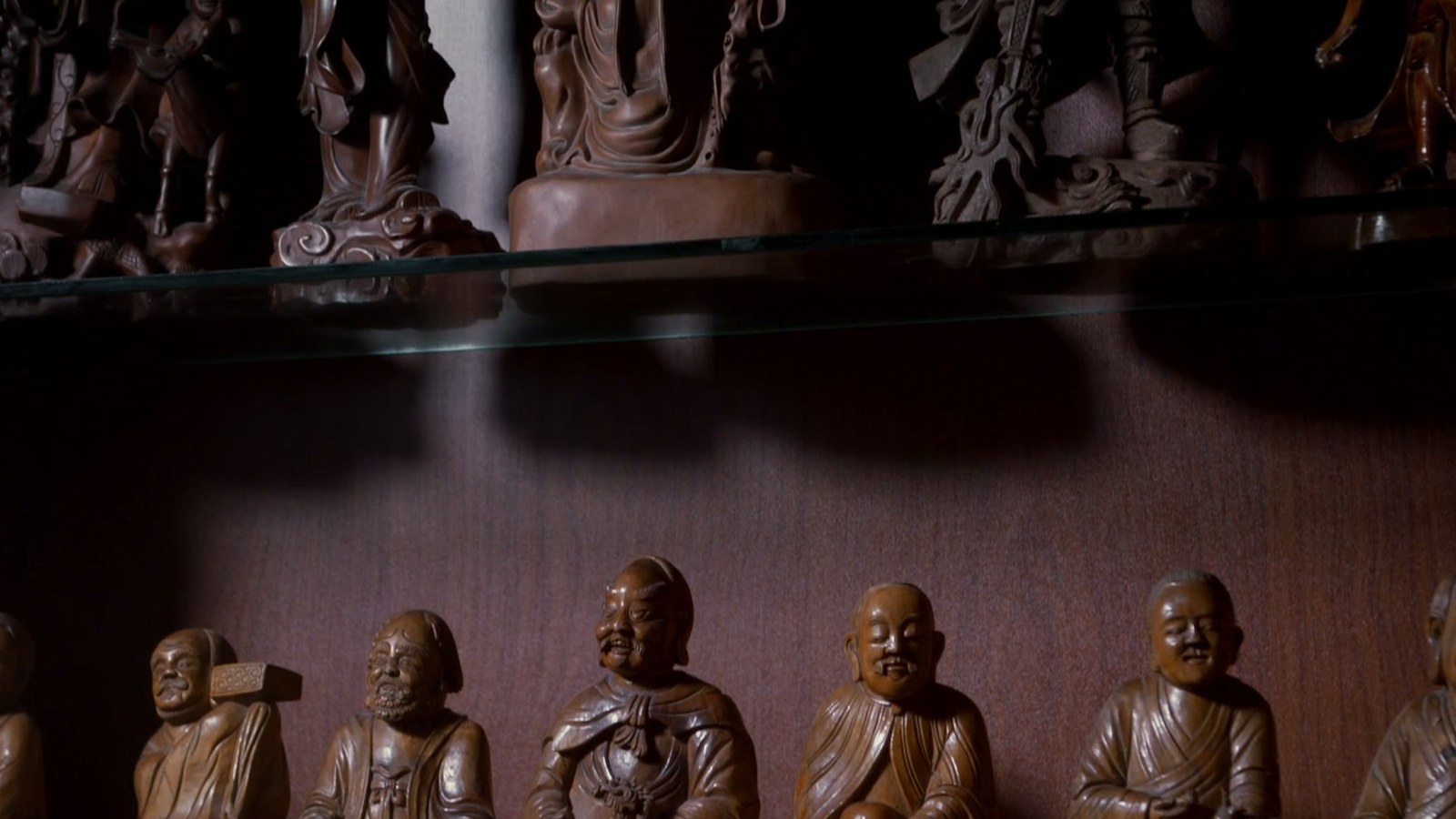
Figure carving is the hard test: a shape can be built, a presence cannot. A hair's difference in the brow and the whole piece falls apart. (Film still)
04
Seven Stages, Every Cut Considered
SelectingConceivingRoughingBlocking the figureRefiningSandingWaxing
Selection reads the grain; conception reads the shape of the root; roughing sets the mass; blocking sets the spirit; refining closes the edge; sanding removes the tool marks; waxing feeds the colour. Only after all seven does a piece stand. The cutting is plain, round and even; figures carry both form and spirit. That quality is not performance. It comes from skipping no stage.
05
Furong Tower: Four Years, Forty-Eight Panels
In 1982, before he had finished his apprenticeship, Fu Zhaohuai followed his father to Furong Tower in Qiancheng to take part in its restoration. He stayed four years. Forty-eight carved doors and windows remain one of his most treasured memories. "The ornament, the cutting, the composition of the pattern — all of it is still very traditional design, and traditional craft."
The figures on the window panels are cut in deep relief. Before each cut there is a decision to make: how the expression should read, how the figure should stand, how the landscape in the story should support it. Figures and scenery share one board, and what holds them apart is the breathing space left in the composition.
06
Furong Fairyland: One Root, Thirty-Plus Stories
After the Furong Tower work was finished, father and son were commissioned by the tower's cultural relics office to make an unprecedented root carving: Furong Fairyland. Standing 1.8 metres tall, it holds more than thirty stories — episodes from the four great classical novels, flowers, birds, insects and beasts — gathered around the celebrated scene of "Seeing Off Xin Jian at Furong Tower".
Technically, openwork and pierced carving were added over the round-carved body so the content could grow richer. The natural shape of the root was then used to set the figures off, which is why the piece reads as lively and crowded. When people saw it at the time, their eyes lit up; in the film's words, it was something remarkable.
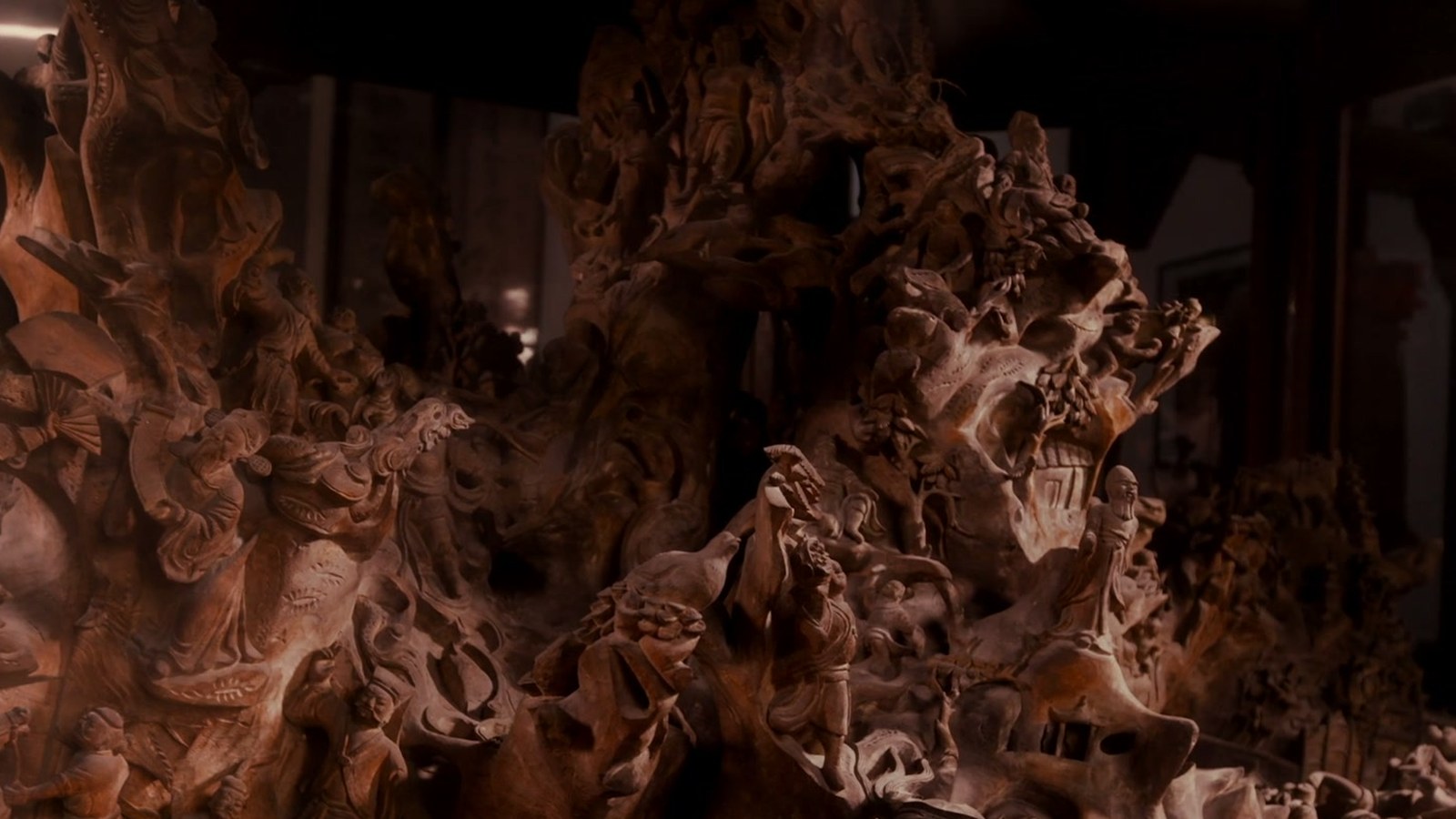
Detail of Furong Fairyland. The root grows as it grows and the composition follows; figures are grown out of the root's skeleton, not placed on top of it. (Film still)
07
Greeting the Immortals: Seven Years, a National Treasure
Greeting the Immortals took father and son nearly seven years. The root carving is now held by the Huaihua Museum as a Grade-One National Cultural Relic, and it marks the high point of Fushi woodcarving. Carved from a thousand-year-old camphor trunk, it employs round carving, relief, pierced carving and multi-layer carving together — dense in layers, vast in presence.
It borrows the scattered perspective and bird's-eye composition of classical Chinese painting so that dozens of figures and episodes can unfold within a single work. Story and the natural beauty of the root complete each other: the piece is both overwhelming and quietly refined. Those two words sound contradictory until you stand in front of it.
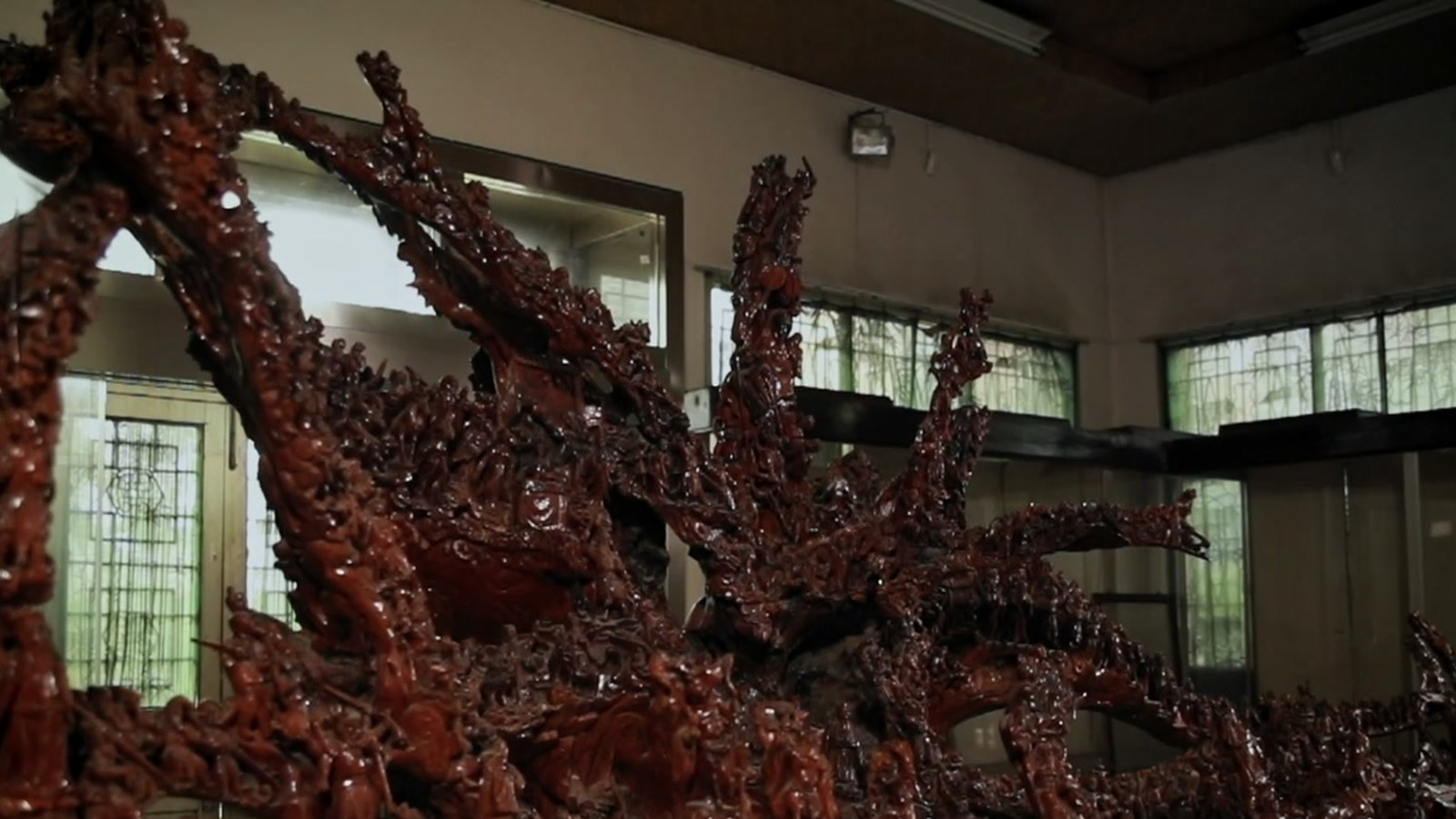
Greeting the Immortals. Fitting a hundred figures into one work is not a matter of piling them up, but of layering and perspective. (Film still)
08
From Craft to Family Discipline
A hundred years of family transmission and generations of affinity with wood and stone have written a remarkable chapter, and left the world an object that carries human intelligence at its best. These works are treasures of Huxiang culture and hold the wisdom and humanist cultivation of the Chinese people; in the grain that the years have passed over, they tell of the brilliance and legend of craftsmanship.
Mr. Fu's household carries this craft, and he has long lived and worked in Huaihua, Hunan, where he has also been in contact with local ritual lineages such as Meishan, Chushi and Baihe. Woodcarving and folk practice are two ends of one thread: a deity image requires a command of form, timber and cutting, and also of the rules and order that govern it once it is installed. A craft survives not usually because it is beautiful, but because it is still in use.
09
About the Documentary
The text and stills on this page come from the first of five documentaries on the craft, "An Overview", running 7 minutes 22 seconds. The Chinese subtitles are burned into the original film; the English subtitles were translated line by line for this site.
Viewing and reuse: the full film is released through the WeChat account "梅山教傅半仙" and video platforms. Stills, screenshots and text may not be reproduced or used commercially without prior written permission.
Scope
This site documents traditional culture, folk memory and intangible heritage craft. It makes no claims regarding medical outcomes, earnings or fate, and does not replace legal, medical, financial or safety judgement.